GizFab
2-1 Exhaust Collector Cutting Fixture
2-1 Exhaust Collector Cutting Fixture
SKU:FT_CCF_2-1
Couldn't load pickup availability
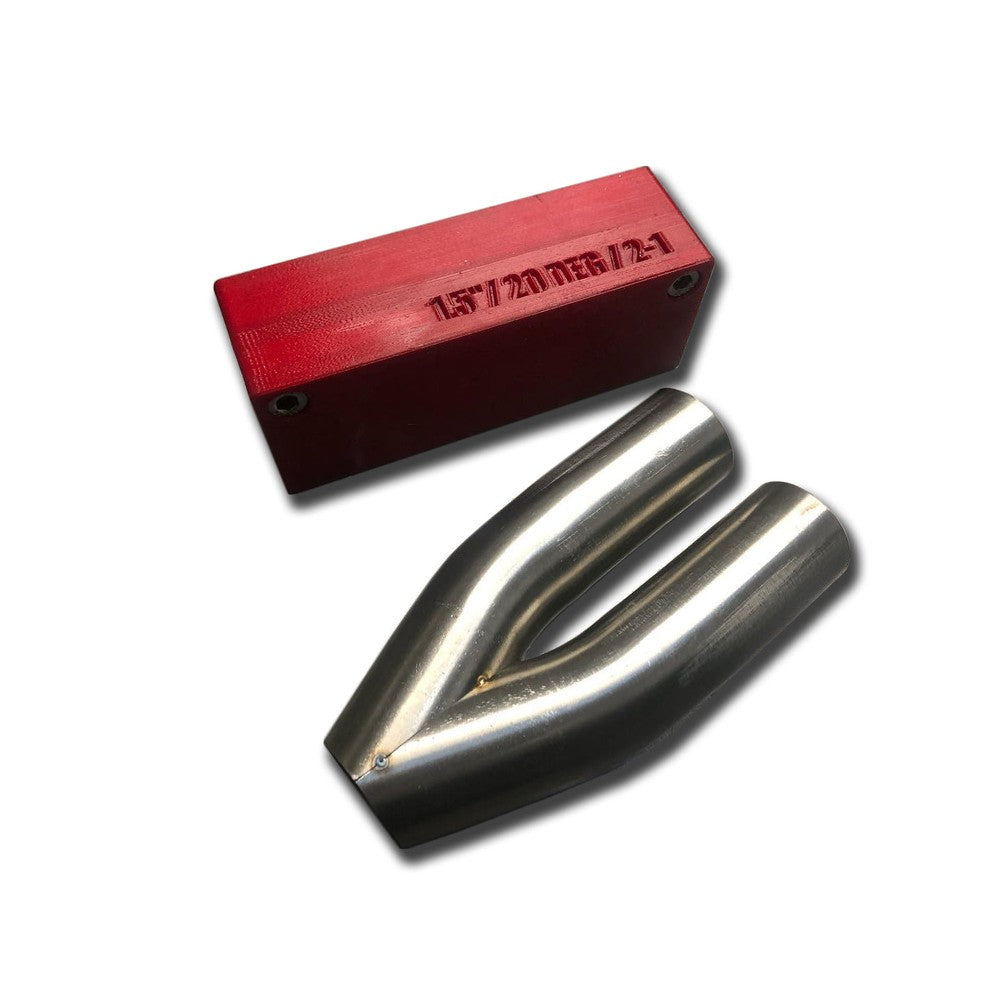
2-1 Exhaust Manifold Collector Jig
The GizFab 2-1 Exhaust Manifold Collector Jig is designed to take the guesswork out of fabricating consistent two-into-one exhaust collectors.
Designed and manufactured in-house, these simple workshop tools allow you to produce reliable, repeatable and equal collector cuts using just three cutting operations.
Primarily designed for use in a bandsaw, the jig securely positions the tubing for each operation, helping ensure both tubes are cut consistently and squarely.
Don't have a bandsaw? The jig can also be used as a positioning and marking tool, allowing the required cut lines to be transferred onto the tube before cutting with your preferred hand or power tools.
Key Features
- Designed & Manufactured In-House by GizFab
- Designed for 2-Into-1 Exhaust Collectors
- Produces Reliable & Repeatable Cuts
- Just 3 Simple Cutting Operations
- Helps Produce Equal Collector Cuts
- Designed for Bandsaw Use
- Can Also Be Used to Mark Cut Lines
- Multiple Tube Diameters Available
- 1.5D & 2D Collector Options
- Ideal for Exhaust & Turbo Manifold Fabrication
- Cost-Effective Alternative to Repeated Manual Measuring
- 12-Month Warranty
Make Repeatable 2-1 Collectors
Fabricating a good two-into-one collector by hand can be surprisingly time-consuming.
Both tubes need to be cut consistently so that when brought together they produce an even collector with good alignment and minimal gaps.
Small differences in cutting angle or position can result in:
- Unequal Collector Lengths
- Poor Tube Alignment
- Large Gaps Between Tubes
- Additional Grinding & Preparation
- Difficult TIG Welding
- Inconsistent Results Between Collectors
Our collector jig provides a fixed reference for positioning the tubing, making it much easier to reproduce the same cuts repeatedly.
This is particularly useful when producing multiple manifolds or exhaust components where consistency between parts is important.
Just 3 Cutting Operations
The jig has been designed so that the required collector profile can be produced using three straightforward cutting operations.
Position the tubing in the fixture, complete the required cuts and you're left with two consistently prepared tubes ready to be brought together and fabricated into your 2-1 collector.
The result is a much quicker and more repeatable process than individually measuring and marking every collector from scratch.
1.5D & 2D Options
The jigs are available in different configurations based on the diameter and bend radius of the tubing being used.
D refers to the tube diameter.
A 1.5D bend has a centreline bend radius approximately 1.5 times the nominal tube diameter, while a 2D bend has a centreline bend radius approximately twice the nominal tube diameter.
For reference:
| Tube Diameter | 1.5D Centreline Radius | 2D Centreline Radius |
|---|---|---|
| 1.5" | 2.25" | 3" |
| 1.75" | 2.625" | 3.5" |
| 2" | 3" | 4" |
Please ensure you select the correct jig for both your tube diameter and bend radius.
For example, a 2" tube with a 3" centreline bend radius is a 2" 1.5D bend, whereas a 2" tube with a 4" centreline radius is a 2" 2D bend.
Designed for Bandsaw Use
The fixture is primarily intended for use with a metal-cutting bandsaw.
Correctly positioning the tubing in a bandsaw can be awkward, particularly when working with bends rather than straight tube.
The jig provides a consistent reference for holding the component during each cutting operation, making it easier to produce the same collector profile repeatedly.
No Bandsaw? Use It as a Marking Jig
You don't necessarily need a bandsaw to benefit from the fixture.
The jig can also be used simply to position the tubing and establish the required cut lines.
Once marked, the tube can be removed from the fixture and cut using your preferred method.
This makes the jig useful for fabricators working with:
- Angle Grinders
- Cutting Discs
- Hacksaws
- Reciprocating Saws
- Other Suitable Tube-Cutting Equipment
Final finishing can then be carried out using a belt grinder, linisher or other appropriate equipment.
Ideal for Manifold Fabrication
These jigs are particularly useful when fabricating:
- Exhaust Manifolds
- Turbo Manifolds
- Exhaust Collectors
- Wastegate Merges
- Downpipes
- Exhaust Systems
- Custom Tubular Fabrication
For production work, they also make it considerably easier to reproduce the same collector geometry across multiple components.
Important - Verify Your Tubing
Tube diameter alone does not determine which fixture you require.
You must also know the bend radius of the bends you intend to use.
For example, two bends can both be manufactured from 2" tubing while having completely different centreline radii.
Always confirm both the tube diameter and bend radius before ordering.
If you're unsure which version you require, drop us a message before ordering.
Important - Do Not Over-Clamp
The fixture only needs to be clamped sufficiently to prevent movement during positioning and cutting.
Do not excessively tighten the bandsaw vice.
Excessive clamping force is unnecessary and may damage the fixture.
Cutting Safety
This product is a workshop positioning fixture only. It does not replace correct machine operation, guarding or appropriate PPE.
Before cutting, always ensure:
- The Tube is Securely Positioned
- The Fixture is Correctly Supported
- The Correct Cutting Position Has Been Selected
- The Bandsaw Blade Cannot Contact the Fixture
- The Workpiece Cannot Rotate During Cutting
- Machine Guards are Correctly Positioned
- Appropriate PPE is Used
Always verify the dimensions and intended collector geometry before cutting your material.
12-Month Warranty*
This product is warranted to the original purchaser against manufacturing defects for a period of 12 months from purchase.
Our obligation under this warranty is limited to repair or replacement, at our discretion, where inspection confirms a manufacturing or material defect.
The warranty does not cover normal workshop wear, cutting or blade damage, heat damage, excessive clamping force, crushing, modification, incorrect use or accidental contact with cutting equipment.
This product is a fabrication aid. The operator remains responsible for verifying tube dimensions, bend radius, cutting positions and final fitment before cutting or welding the workpiece.